/
/
 ChatGPTChatGPT
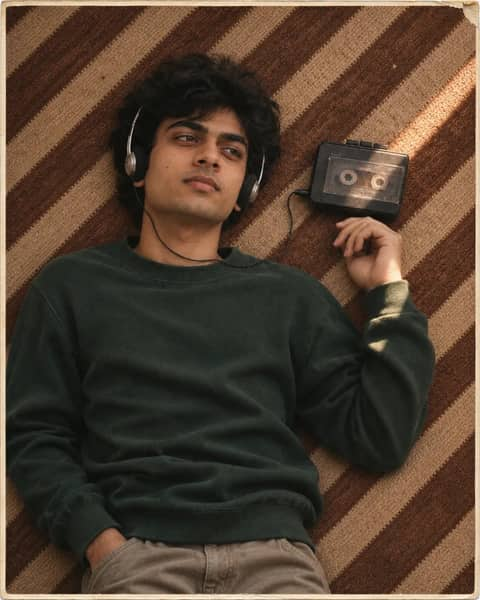
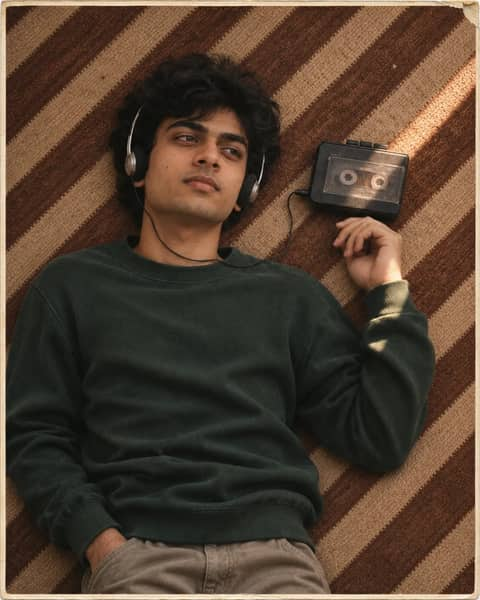
Silver wired headphones, a striped rug and a sunlit cassette player give this overhead portrait a nostalgic album-cover feel in ChatGPT.

Quick workflow
Copy the prompt, customize any details, and generate in ChatGPT.
Open ChatGPT in your browser or app.
Upload your selfie to use your own face (or skip to make a new character).
Copy the prompt card above and paste it into the chat.
Press send to generate. Adjust any details you want.
Browse our curated library of tested AI image prompts or filter by your favorite tool.
Guide
This prompt generates a top-down 35mm film portrait of a man lying on a striped wool rug beside a vintage portable cassette player, listening through wired over-ear headphones. It produces a faded, physical print look reminiscent of an indie folk album insert or a 1990s music magazine spread, complete with an off-white border and directional window light.
Top-down portraits easily fall flat if every object sits on the exact same focal plane. Specifying 35mm at f/4 solves this. While an ultra-wide aperture like f/1.4 creates heavy background blur in standard portraits, it ruins an overhead composition by turning the rug and the cassette player into indistinguishable mush. An aperture of f/4 gives enough depth of field to keep the cassette spools, the knit of the forest-green sweatshirt, and the facial features sharp, while letting the floor fall off just enough at the edges.
The lighting prompt relies on two distinct light sources to split the frame visually:
Keep the aperture at f/4 for overhead gear shots
Dropping below f/2.8 on top-down views often blurs the cassette player into a plastic blob. Setting f/4 preserves mechanical details like the tape heads, reels, and headphone jack connection.
Each image engine handles physical props and analog color science differently.
GPT IMAGE 2.5 tracks mechanical objects best
Use GPT IMAGE 2.5 when you need the headphone wire to run logically from the earcups directly into the 3.5mm jack on the player without vanishing mid-frame.
GPT IMAGE 2.5 manages the spatial layout with high precision. When you ask for the head to sit left of center and the player on the right, it leaves proper negative space without crowding the composition. It also follows physical logic well: the headphone cable actually connects to both components rather than disappearing into the rug pile. The color response leans slightly cooler, so the forest green comes out deep and muted rather than oversaturated.
Nano Banana Pro delivers exceptional film texture. The print border, paper aging, and soft highlight rolloff on the man’s skin look tactile right out of the gate. However, it can sometimes treat the headphone cable as a decorative line, causing it to loop into bizarre shapes or merge into the rug stripes. If you use Nano Banana Pro, keep your prop prompt short and explicit about where items connect.
Overhead compositions with cables and mechanical electronics present specific failure points.
Generators love plastering garbled fake brand names across vintage audio gear and blank cassette labels. If your output shows gibberish text on the cassette door or sweatshirt, add unbranded equipment, plain blank cassette shell, solid green sweatshirt without graphics to your prompt. Mentioning "no lettering" in the negative space also protects the border from unwanted watermarks.
Because the rug has brown-and-tan diagonal stripes, AI models often blend the dark headphone cord into the rug lines.
Top-down lighting can cause digital models to render skin with an artificial plastic shine, especially across the cheekbones and forehead.
Next ideas
 ChatGPTModel:GPT IMAGE 2.5