/
/
 ChatGPTChatGPT
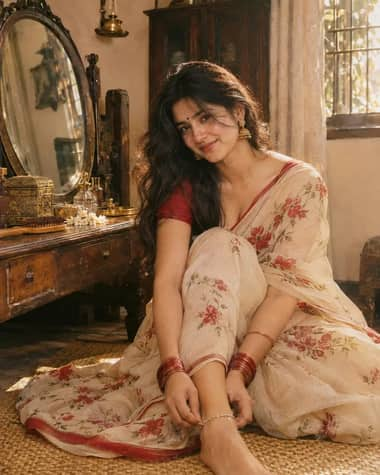
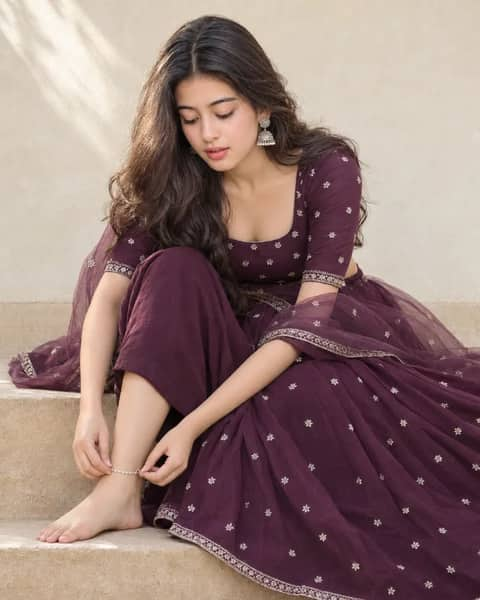
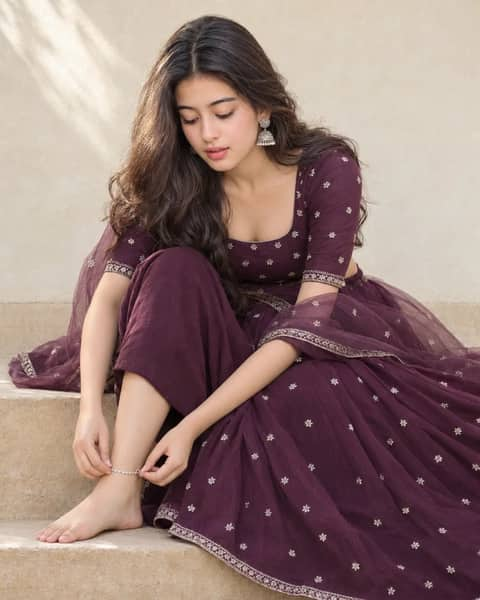
A plum lehenga spreads across sandstone steps as she fastens a silver anklet in this graceful seated fashion portrait for ChatGPT.

Quick workflow
Copy the prompt, customize any details, and generate in ChatGPT.
Open ChatGPT in your browser or app.
Upload your selfie to use your own face (or skip to make a new character).
Copy the prompt card above and paste it into the chat.
Press send to generate. Adjust any details you want.
Browse our curated library of tested AI image prompts or filter by your favorite tool.
Guide
This prompt produces a vertical 4:5 editorial portrait of a woman seated on pale sandstone steps, caught mid-motion as she fastens a silver anklet against a plum lehenga. The composition leans on classic Indian bridal and festive portraiture, where quiet, candid gestures replace stiff poses facing the camera.
Most AI fashion portraits suffer from flat staging. When you ask a generator to show someone sitting down, it usually drops them squarely in the center of the frame facing forward. This prompt breaks that habit by anchoring the model diagonally across three steps.
Her torso faces left on the middle tier while her profile sits near the upper right. That setup creates natural lines across the frame. Her bare foot rests lower down on the left, giving the lower half of the picture a clear visual anchor.
[Profile: Upper Right] ───┐ ▼ [Torso: Center Left] │ ▼ [Hands & Foot: Lower Left]
Setting the virtual camera to 50mm at f/5.6 is deliberate. Beginners often push prompts toward f/1.2 or f/1.4, thinking shallow focus always looks better. At f/1.4, an image spanning three physical planes turns into mush. Her hands, the silver anklet, and the skirt folds would blur away into an indistinct haze. An f/5.6 aperture keeps her profile, her hands, and the hem of her lehenga sharp while letting the plain limewashed wall behind her soften naturally.
Keep the aperture narrow for seated poses
Do not use f/1.4 or f/1.8 when the subject's limbs sit on different physical planes. An aperture of f/4 to f/5.6 keeps her hands, feet, and face all within the depth of field.
Generators default to high-gloss silk or reflective satin when they read the word "lehenga". That shine turns into hot white patches under daylight settings.
Specifying a "matte plum" base prevents artificial plastic gloss. It leaves the fabric looking like dense raw silk or heavy cotton-chanderi that absorbs light. The small silver motifs stay distinct because they sit against dark, flat fabric instead of a sea of confusing reflections. Moving the sheer dupatta behind her elbows keeps her chest, waist, and hands free from competing layers. You get clean lines where her hands meet her ankle without sheer fabric blurring the fingers.
Both tools handle this prompt well, but their priorities differ.
Pick Nano Banana Pro for authentic stone and wall grain
Use Nano Banana Pro if you want realistic chalky plaster and coarse stone steps. Switch to GPT IMAGE 2.5 if you want tighter adherence to the fanned skirt layout.
Small jewelry interactions cause messy hand generation. The model tries to render tiny silver links and fingernails in the same small cluster of pixels. If the fingers look melted, edit the prompt to separate the actions: change "one hand steadies the silver anklet and the other fastens it" to "her right hand holds the open silver clasp near her ankle, left hand resting on her foot". Simplifying the grip reduces fused geometry.
Deep purple dyes can bleed into adjacent pixels during generation. This leaves the woman's bare foot and the sandstone steps looking bruised or stained with magenta. Counter this by adding "warm sandstone, neutral gray shadows, realistic skin undertones" into your prompt tweaks.
If the lehenga bundles under her knees instead of spreading to the right, the prompt needs clearer directional cues. Replace "fan the skirt across the step to frame right" with "hem of the skirt spread flat across the surface of the step, trailing off toward the right edge of the frame". Giving the fabric a clear path prevents the model from bunching it into a ball.
Next ideas
 ChatGPTModel:GPT IMAGE 2.5